Explore the introductions below. Each topic starts with context, the information you can organize and the conversation to have with your veterinarian.
Breathing
Notice the everyday pattern
Start with what you notice during ordinary rest and activity. A dated description gives your veterinarian more context than trying to remember a change later.
KEEP IN MIND
Record the setting, what you noticed and whether it has happened before. Observations are context for your vet, not a breathing test.
Brachycephalic obstructive airway syndrome (BOAS) is a condition involving obstruction of the upper airways in short-muzzled dogs, including French Bulldogs.
KEEP IN MIND
A checklist cannot diagnose BOAS or grade its severity. Ask your veterinarian about assessment and what the findings mean for your dog.
Research from the Royal Veterinary College identifies French Bulldogs among breeds at increased risk of skin fold dermatitis. Small observations can be useful to share at a consultation.
KEEP IN MIND
Keep dated notes about changes in the skin or folds and the care plan your veterinarian has given you. Follow that plan rather than choosing a treatment from a checklist.
Vomiting, regurgitation and stool changes can be difficult to tell apart. A clear note about timing, appearance and what your dog was doing helps your veterinarian assess the pattern.
KEEP IN MIND
Recurring digestive signs should not be dismissed as “just the breed.” Note meals, episodes, stool, appetite and energy, then share the pattern with your vet.
Look for changes in eye comfort, clarity, discharge or ear odor and scratching. French Bulldogs can be more prone to some eye-surface and ear problems.
KEEP IN MIND
Squinting, a closed or cloudy eye needs prompt veterinary advice. Persistent ear discomfort, odor or discharge also deserves a veterinary check.
A dated weight log helps you bring a clear record to your next appointment. Include the unit and how the measurement was taken so the entries have useful context.
KEEP IN MIND
Your veterinarian can help interpret the record and set an appropriate plan. This overview does not assign an ideal weight or calculate a feeding allowance.
A slower rise, a changed walk or reluctance to move can be useful to describe. French Bulldogs have increased risk of some spinal conditions, but a change in movement can have many causes.
KEEP IN MIND
Record when it began, what movement changed and whether it is worsening. Sudden weakness, wobbliness, paw dragging or inability to stand needs urgent veterinary advice.
Does this page tell me whether my Frenchie is healthy?
No. This is an educational overview of topics and record keeping. It does not diagnose conditions, assess severity or replace an examination by your veterinarian.
What is the free health assessment for?
The assessment provides an educational overview based on your answers. It is a starting point for organizing topics to discuss, not a diagnosis or a decision about whether veterinary care is needed.
Can FrenchieOS help me organize these observations?
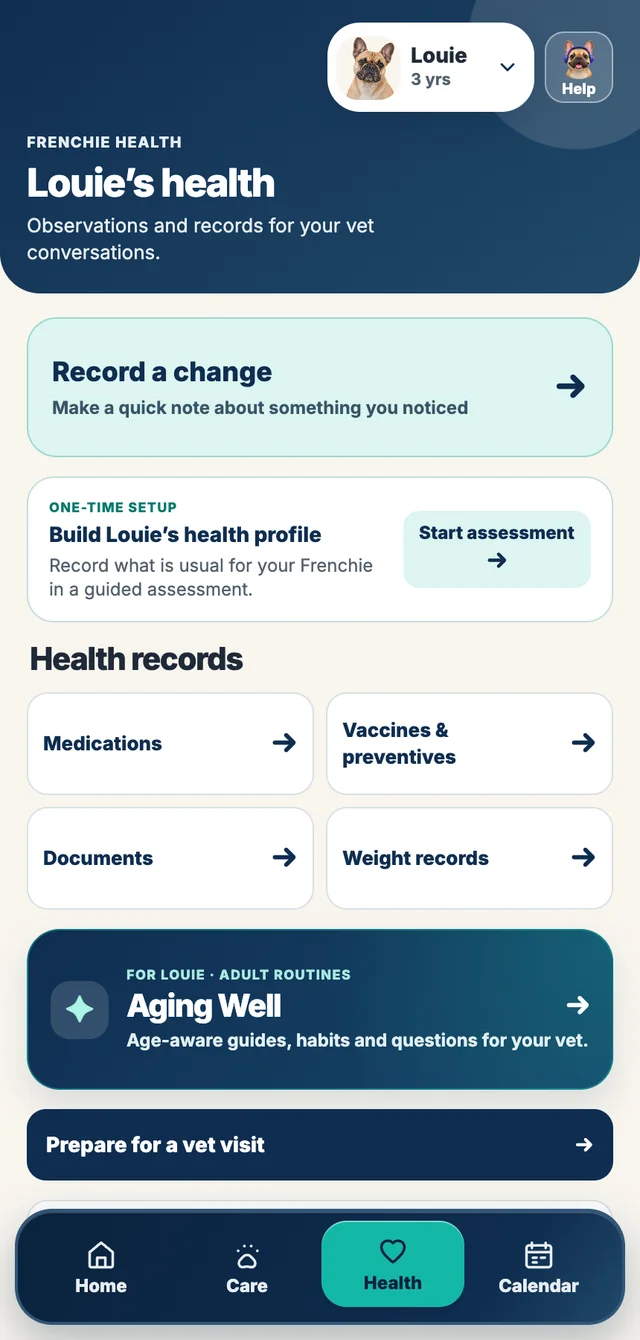
FrenchieOS helps you keep daily check-ins, dated observations and weight records together in your browser.
Background reading
Go to the source.
These veterinary resources support the background information about BOAS and skin folds. They are independent resources, not endorsements of FrenchieOS.