
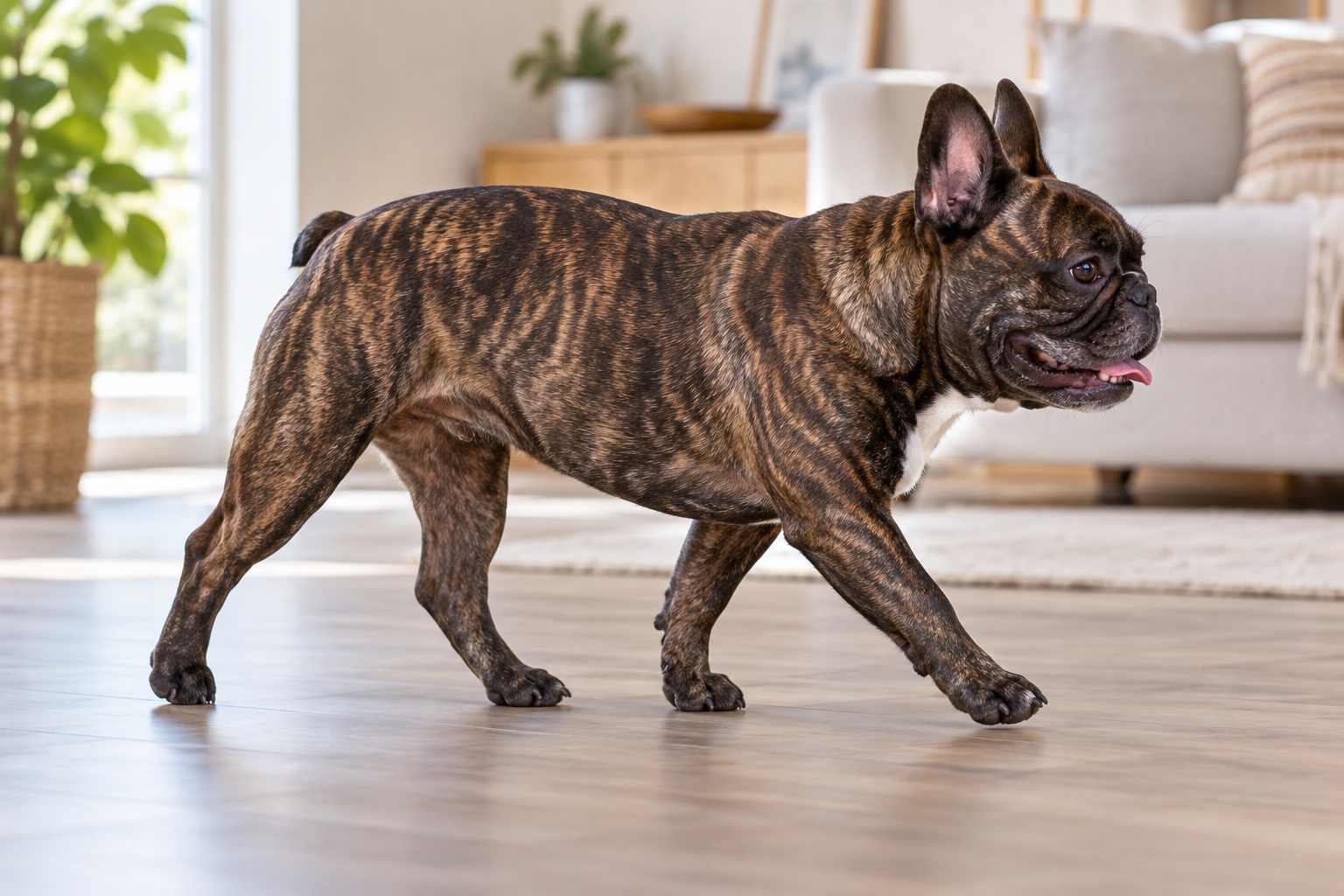
Mobility is more than a limp
Mobility includes how your Frenchie stands, rises, walks, turns and manages everyday activities. A change can come from a paw, joint, muscle, back or nerves, among other causes. You do not have to identify which one: noticing what is different from your dog’s usual movement is a useful first step.
French Bulldogs have increased risk of some spinal conditions, including intervertebral disc disease (IVDD). This is helpful context, not a diagnosis. RVC notes that vertebral differences can also appear in French Bulldogs that show no related clinical signs, so an image or breed trait alone cannot tell you whether a problem is affecting your dog.
Background: Royal Veterinary College · Neurology in brachycephalic breeds · Cornell University · CDDY and IVDD .
What changes can I observe at home?
Watch your dog during ordinary, comfortable movement on a level, non-slip surface. Do not make them jump, climb stairs or repeat a movement to capture a video. Changes worth noting include:
- taking longer to get up, lying down or settle into a comfortable position;
- hesitating before a usual walk, turn, step or low threshold;
- limping, shorter steps, stiffness or a change in pace;
- wobbling, stumbling, crossing the legs, scuffing the nails or placing a paw on its top;
- a hunched back, guarded neck, yelping, trembling or reacting when moved;
- new difficulty squatting to urinate or defecate, or changes in bladder or bowel control.
One awkward step can happen for many reasons. A new, repeated, worsening or painful change deserves a call to your veterinary team. Sudden weakness, poor coordination or trouble standing can be urgent.
Three useful ways to look at movement
These images connect everyday observations with the structures a veterinarian may assess. The photos show ordinary moments to notice; the anatomy illustration simplifies one possible spinal-disc problem. None can diagnose your dog.
When is mobility trouble urgent?
Contact an emergency veterinary service now if your Frenchie suddenly cannot stand or walk, develops marked weakness or wobbliness, drags or knuckles a paw, or has severe back or neck pain. New loss of bladder or bowel control alongside mobility changes also needs urgent assessment. Spinal signs can worsen quickly, and prompt veterinary evaluation matters.
Keep your dog as still and comfortable as you can while you call for instructions. Avoid bending or testing the back, stairs, jumping, massage or human pain medicine. If you are unsure how to move your dog safely, ask the clinic before transporting them.
For a new limp or stiffness without these severe signs, call your regular veterinarian for advice and an appointment, especially if it persists, recurs or worsens.
Clinical context: Cornell University · Diseased spinal disks .
What will the veterinarian check?
Your vet may ask when the change began, whether it appeared suddenly, which movements are affected and how it has changed. They may examine the paws and joints and perform a neurologic assessment of strength, coordination and reflexes. Imaging or referral to a veterinary neurologist may be recommended depending on the findings.
An X-ray can show bones and some structural changes, but it does not by itself confirm every disc or spinal-cord problem. CT or MRI may be needed for certain questions. The right tests and treatment depend on the examination and your dog’s specific signs.
Do not start strict crate rest, exercises, supplements or medication based on an online guide. Ask your vet what activity is safe while you wait and follow their individualized plan.
Further reading: American College of Veterinary Surgeons · Intervertebral disc disease · Cornell University · Diseased spinal disks .
Make a useful record without testing your dog
A short note or video of a movement that happens naturally can help your vet understand what you saw. If it is safe and does not delay care, record:
- the date and time, what your dog was doing and the surface;
- which limb or part of the body seemed affected, and what the movement looked like;
- whether the change started suddenly or gradually, and if it is improving or worsening;
- any pain response, stumbling, nail scuffing, appetite change or difficulty toileting;
- recent falls, rough play, new activity, prior episodes or veterinary advice.
Keep floors grippy and block unsupervised jumping if your veterinarian recommends it. Ask before changing exercise, using a ramp or starting rehabilitation. Do not repeatedly prompt a movement to compare or film it.
Common questions
Does every French Bulldog have a spinal problem?
No. French Bulldogs have increased risk of some spinal disorders, but risk does not mean every dog is affected. Some vertebral differences can be seen in dogs without related signs. A veterinarian assesses the individual dog.
Can I wait and see if a sudden limp improves?
A sudden change can have several causes. Call your veterinary team for triage, especially if your dog seems painful. Weakness, wobbliness, paw dragging, inability to stand or loss of bladder or bowel control needs urgent veterinary attention.
Should I massage my Frenchie’s back or make them rest?
Do not manipulate the spine or choose a treatment plan yourself. Ask a veterinarian what to do; the safe activity level depends on the cause and examination.
Can a video replace an examination?
No. A short video can help describe a naturally occurring change, but it cannot test pain, strength, sensation or reflexes. Do not delay care to record one.